Ngorongoro Crater sits within the Ngorongoro Conservation Area (NCA), a UNESCO World Heritage Site and multiple land-use area rather than a conventional national park, and it ranks among East Africa's most rewarding birding destinations. More than 500 bird species have been recorded across the wider NCA, spanning crater floor grasslands, montane forest on the caldera rim, acacia woodland, and the alkaline waters of Lake Magadi, a soda lake on the crater floor. Lake Magadi is a major flamingo habitat, regularly hosting dense flocks of Lesser and Greater Flamingos alongside pelicans, storks and wading birds. Raptors patrol the crater skies year-round, while grassland specialists such as ostrich and kori bustard share the floor with resident waterfowl. Migratory Palearctic species swell numbers between November and May, making this a standout stop for birders, photographers and safari travelers researching Ngorongoro Crater birds, Ngorongoro birding safaris, and where to see flamingos in Tanzania.
Six habitats, hundreds of species — where to look across the crater floor and rim
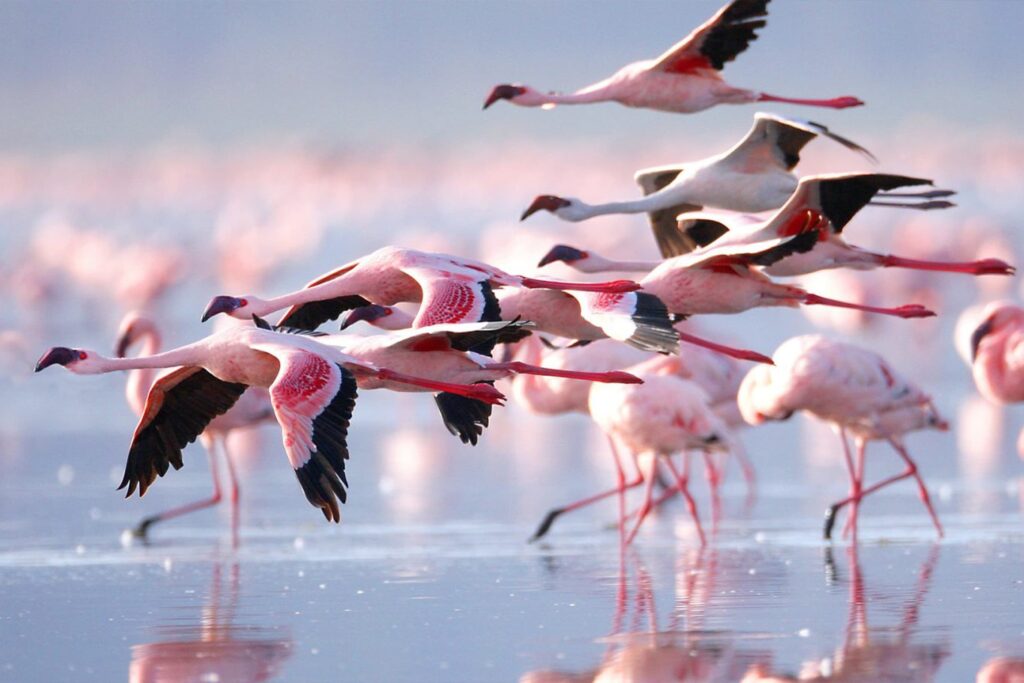
Lake Magadi, the shallow soda lake on the Ngorongoro Crater floor, is East Africa's most reliable flamingo spectacle. Lesser Flamingos gather here by the thousand to filter-feed on blue-green algae in the alkaline shallows, often joined by smaller numbers of Greater Flamingos. Flock sizes shift with rainfall and lake levels, but pink-tinged waters against the crater walls remain one of Ngorongoro's most photographed sights, viewed from the crater floor track.
The crater's open floor and rim forests support a strong raptor population. Augur buzzards soar on rim thermals, while tawny eagles, black-chested snake eagles and African fish eagles hunt over the grassland and Lake Magadi shoreline. Rüppell's and white-backed vultures gather quickly at lion and hyena kills alongside marabou storks, and secretary birds stride through the grass hunting snakes and rodents. Raptor sightings are frequent on any full-day crater floor game drive.
Beyond Lake Magadi's flamingos, the crater's seasonal pools, marshes and the Ngoitokitok springs area attract a wide range of waterfowl. Egyptian geese, yellow-billed ducks and various teal species dabble in shallow water, while grey herons, black-headed herons, saddle-billed storks and African spoonbills wade the margins hunting fish and invertebrates. Little grebes and African jacanas favor the reed-fringed pools, adding further variety for birders working the crater's wetter corners between game drives.
The crater floor's open grasslands mirror the Serengeti's plains birdlife. Common ostriches, the world's largest bird, stride across the short grass in small groups, while kori bustards, among the heaviest flying birds, forage nearby with a slow, deliberate gait. Grey crowned cranes, crowned lapwings and yellow-throated longclaws add color underfoot, and black-winged lapwings patrol the drier margins. These ground-dwelling species are easily spotted from a vehicle throughout the crater floor circuit.
The montane forest cloaking the crater's rim and the Lerai forest on the floor hold a different bird community from the open grassland below. Silvery-cheeked hornbills, white-eyed slaty flycatchers, various sunbirds and forest weavers favor the denser canopy, while crowned eagles occasionally hunt over the forest edge. This transition zone between highland forest and crater floor grassland adds valuable habitat diversity, rewarding birders who pause along the descent and ascent roads.
Birding is productive year-round on the crater floor, but the wet season (November to May) boosts numbers with Palearctic migrants and breeding plumage. Lake Magadi and the Ngoitokitok springs area are the top wetland stops, while the crater rim forest and descent road suit forest species. Because access is via timed game-drive permits, most visitors combine birding with general wildlife viewing on a single full-day circuit rather than a dedicated specialist route.
Northern Circuit itineraries built for wildlife and birdlife on the crater floor

A six-day Serengeti and Ngorongoro combination built for multi-generation travelers.
View Package →
An eight-day tour across Tanzania's top northern circuit parks.
View Package →

A nine-day fully private safari through Tanzania's northern circuit highlights.
View Package →
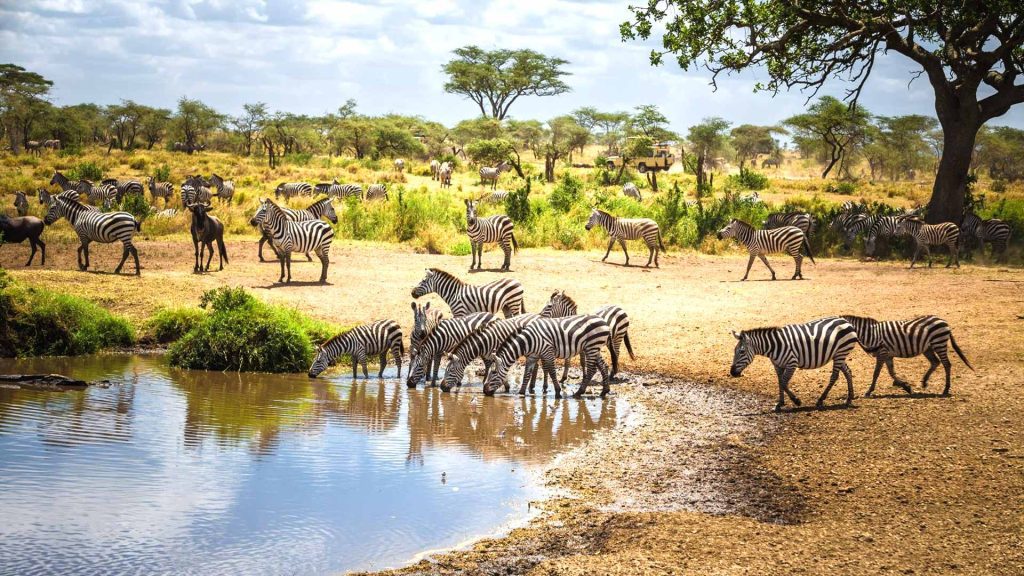
A ten-day journey across Tanzania's most celebrated northern parks.
View Package →
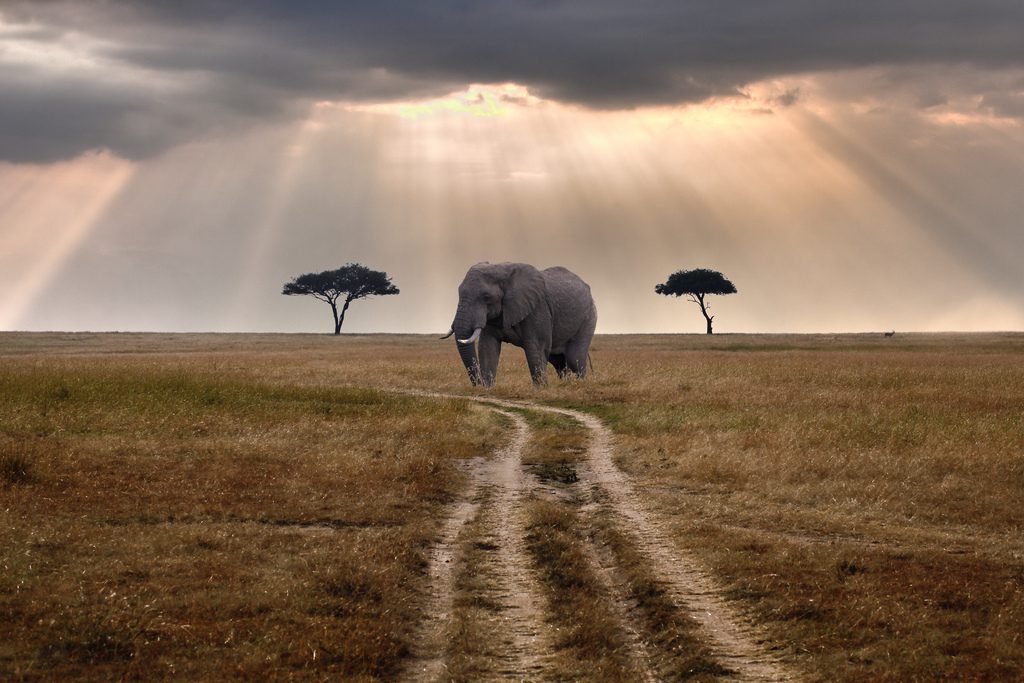
Ten days combining the very best of the northern safari circuit.
View Package →
A classic nine-day Serengeti safari showcasing the park's iconic wildlife.
View Package →
Eight days following the wildebeest migration across the Serengeti plains.
View Package →
Seven days showcasing the very best of African wildlife.
View Package →More than 500 bird species have been recorded across the Ngorongoro Conservation Area (NCA), which includes the crater floor, the surrounding highlands, and the Serengeti-adjacent plains toward Ndutu. Within the crater itself, birders regularly log well over 100 species in a single full-day game drive, ranging from flamingos on Lake Magadi to raptors patrolling the rim thermals. This diversity reflects the crater's mix of habitats: alkaline lake, open grassland, acacia woodland, swamp and montane forest, all compressed within a roughly 260-square-kilometer caldera floor. For birders combining a Ngorongoro visit with the Serengeti or Lake Manyara, species counts climb even higher across a multi-park itinerary.
Yes — Ngorongoro Crater ranks among Tanzania's top birdwatching destinations, combining exceptional species diversity with easy vehicle-based access. Unlike specialist birding reserves that require dedicated multi-day trips, the crater delivers strong birding as a byproduct of a standard game drive, since raptors, flamingos, storks and grassland species are visible alongside lions, elephants and rhinos on the same route. The compact, roughly 260-square-kilometer floor concentrates habitats — soda lake, swamp, grassland and forest edge — into a single half-day or full-day circuit, so visitors don't need extra time or a specialist permit to see excellent birdlife alongside the crater's famous mammals.
Lake Magadi, the shallow soda lake spanning much of the western and southern crater floor, is the best and most reliable place to see flamingos in Ngorongoro Crater. Thousands of Lesser Flamingos gather here to filter-feed on algae in the alkaline shallows, with smaller numbers of Greater Flamingos often mixed in. Viewing points along the crater floor track and the lake's northern and western edges offer good vantage without disturbing the birds. Flock size and exact location shift with rainfall and water levels, so an experienced local guide who tracks recent conditions gives the best chance of a strong flamingo sighting on the day of your visit.
Lake Magadi is a shallow, alkaline soda lake occupying much of the Ngorongoro Crater floor, fed by seasonal streams draining from the crater walls and rim. Its high mineral content comes from volcanic soils and limited outflow, creating the alkaline chemistry that supports blue-green algae — the primary food source for the Lesser Flamingos that gather here in large numbers. The lake's size and color shift with rainfall, sometimes shrinking to a cracked, pink-tinged pan in the dry season and expanding after rains. Beyond flamingos, its margins attract pelicans, storks and wading birds, making it the single most important wetland habitat within the crater ecosystem.
Lesser Flamingos are smaller, deeper pink, and far more numerous at Lake Magadi, gathering by the thousand to filter-feed on blue-green algae using specially adapted bills suited to the lake's alkaline chemistry. Greater Flamingos are larger, paler pink-white with black-tipped wings, and typically present in smaller numbers, feeding on small invertebrates and algae in slightly deeper water. Both species can appear in the same flock, and distinguishing them at a distance often comes down to height, bill shape and overall color saturation. Guides familiar with the crater floor can point out both species side by side during a single game drive stop at the lake.
Ngorongoro Crater supports a strong raptor community across its grassland, lake and rim forest habitats. Augur buzzards soar on thermals rising off the crater walls, while tawny eagles, black-chested snake eagles and African fish eagles hunt over open grass and the Lake Magadi shoreline. Rüppell's and white-backed vultures descend quickly on lion and spotted hyena kills alongside marabou storks, performing an essential scavenging role in the ecosystem. Secretary birds stride through the grass hunting snakes and rodents on foot rather than in flight. Because raptors follow predator activity, sightings are frequent on almost any full-day crater floor game drive.
Beyond Lake Magadi's flamingos, the crater's marshes, springs and seasonal pools — particularly around the Ngoitokitok picnic site — support a wide range of waterbirds. Egyptian geese, yellow-billed ducks and various teal dabble in shallow water, while grey herons, black-headed herons, saddle-billed storks and African spoonbills wade the margins hunting fish and invertebrates. Little grebes and African jacanas favor reed-fringed pools, and great white pelicans occasionally visit the larger open water. This mix of resident and seasonal wetland species adds meaningful diversity to a crater floor game drive beyond the headline flamingo spectacle at Lake Magadi.
Yes — common ostriches, the world's largest living bird, are a frequent and easy sighting on Ngorongoro Crater's open grasslands, often moving in small family groups across the short grass. Kori bustards, among the heaviest flying birds in the world, forage nearby with a slow, deliberate walk, their pale plumage blending into dry-season grass. Grey crowned cranes, crowned lapwings and yellow-throated longclaws add further color to the same grassland habitat. These ground-dwelling species are easily photographed from a vehicle without needing to leave the standard game-drive route, making them among the most reliably spotted birds in the crater.
The montane forest cloaking the crater rim, along with the Lerai forest near the crater floor, hosts a distinct bird community compared to the open grassland below. Silvery-cheeked hornbills, white-eyed slaty flycatchers, various sunbird species and forest weavers favor the denser canopy and forest edge, while crowned eagles occasionally hunt along the forest margins. This highland forest zone, cooler and wetter than the crater floor, marks a sharp habitat transition within a short drive. Birders who pause along the steep descent and ascent roads, rather than only birding the floor, often add several forest species to their day's checklist.
Birding is productive in Ngorongoro Crater year-round, since resident species — flamingos, raptors, storks and grassland birds — are present in every season. The wet season, roughly November through May, adds significant value by bringing Palearctic migrants such as European rollers, barn swallows and various waders, alongside breeding plumage on many resident species. Water levels on Lake Magadi also tend to be higher in the wet season, often supporting larger flamingo flocks. The dry season (June to October) offers easier road access and concentrates wildlife around remaining water sources, which can make both birds and mammals easier to locate.
Yes — in Ngorongoro Crater, birdwatching and general game viewing happen naturally on the same drive rather than requiring separate excursions. Because crater floor access is limited to timed vehicle permits and a single descent and ascent road, virtually all visitors explore the crater on a standard game drive, during which flamingos, raptors, storks and grassland birds are visible alongside lions, elephants, rhinos and wildebeest. Drivers experienced with the crater know where recent bird activity has concentrated, particularly around Lake Magadi and the Ngoitokitok springs, and can pause there without disrupting the broader wildlife-viewing itinerary planned for the day.
No — Ngorongoro Crater is not technically a national park. It sits within the Ngorongoro Conservation Area (NCA), a UNESCO World Heritage Site managed under a multiple land-use model that, unlike a national park, permits Maasai pastoralists to live within its boundaries alongside protected wildlife. This distinction affects logistics: the NCA charges its own conservation fees, operates under separate crater-descent permits and vehicle quotas, and is administered by the Ngorongoro Conservation Area Authority rather than Tanzania National Parks. For visitors, the practical experience is similar to a national park safari, but the designation matters for permits, fees and how the area is described in official travel documentation.
Ngorongoro Crater and the Serengeti both offer excellent birding but differ in character. The crater's compact, roughly 260-square-kilometer floor concentrates diverse habitats — soda lake, swamp, grassland and forest edge — into a single accessible circuit, making it efficient for spotting flamingos, raptors and waterbirds in a short visit. The Serengeti's vastly larger area spreads birdlife across riverine forest, endless plains and additional soda lakes like Lake Natron, rewarding longer stays with a broader overall species list. Many Foot Slopes Tours itineraries combine both parks, letting travelers enjoy the crater's concentrated flamingo and raptor sightings alongside the Serengeti's larger-scale diversity.
Foot Slopes Tours and Safaris designs Ngorongoro Crater itineraries around experienced local guides who know exactly where recent bird activity is concentrated, from flamingo flocks on Lake Magadi to raptor activity near fresh predator kills. Rather than a generic game drive, the team times crater descent permits, routes and pacing to maximize both birdlife and general wildlife viewing within the same day. Private vehicles, flexible stops at wetland and forest-edge birding spots, and knowledgeable driver-guides mean birders and general safari travelers alike get a well-paced, informative crater experience. This local expertise, built from repeated visits to the crater, is difficult to match with a generic tour operator.
Yes — Foot Slopes Tours and Safaris builds tailor-made itineraries that can emphasize birding within a Ngorongoro Crater safari, whether that means extra time at Lake Magadi for flamingo photography, an early departure to catch raptor activity, or a route through the Lerai forest edge for forest species. These itineraries can also combine Ngorongoro with other strong birding areas such as Lake Manyara, Tarangire and the Serengeti's Seronera valley for a broader Northern Circuit species list. Because every trip is planned individually rather than from a fixed template, travelers can specify birding priorities in advance and have the itinerary, pacing and guide briefing adjusted accordingly.
Yes — Foot Slopes Tours and Safaris' driver-guides are trained and experienced in identifying the crater's bird species alongside its mammals, from distinguishing Lesser and Greater Flamingos at Lake Magadi to recognizing raptors, storks and grassland specialists like kori bustards and grey crowned cranes. This dual expertise means birders traveling with Foot Slopes Tours and Safaris get informed commentary and well-timed stops without needing a separate specialist birding guide. Guides also track seasonal patterns, such as when Palearctic migrants arrive or when Lake Magadi's flamingo flocks are largest, helping travelers plan their crater visit for the strongest possible birding results on any given date.
Yes — Foot Slopes Tours and Safaris has extensive experience operating safaris into Ngorongoro Crater as part of Tanzania's Northern Circuit, handling the logistics of conservation fees, timed crater-descent permits and vehicle quotas that the Ngorongoro Conservation Area requires. This operational familiarity means fewer delays at the crater gate and more time actually spent viewing wildlife and birds on the floor. Combined with knowledgeable local guides and flexible, tailor-made itinerary planning, Foot Slopes Tours and Safaris is well positioned to deliver a smooth, well-paced Ngorongoro Crater experience for birders, photographers and general safari travelers alike, whether as a day trip or part of a longer Northern Circuit journey.
Tell us your dates, style, and preferred parks, and we will build the perfect itinerary around you.
Book Now Online →Real 5-star reviews from guests who traveled with us
Our Private African luxury Safari experience with Foot Slopes Tours and Safaris was nothing short of exceptional. From the very beginning, owner Gabriel was incredibly responsive, making the entire booking process smooth and stress-free. Gabriel went above and
We had an incredible private safari experience with Foot Slopes Tours and Safaris. Their office staff was very helpful and informative, and they communicated very well. Our pick-ups to and from the airport were on time and hassle-free, an unforgettable Safari
Foot Slopes Tours and Safaris is truly one of the best local tour companies in Tanzania. From start to finish, their service was professional, reliable, and personalized. The team went above and beyond to make sure every detail of our trip was perfect. Our saf
Our family chose Foot Slopes Tours and Safaris for a custom 11-day safari itinerary, and we couldn’t be happier with our choice! Everything from our initial inquiry to building our custom itinerary to pre-departure and on-trip support was top quality. Communic