African Safari Tours

Tarangire National Park Birds & Birding

Tarangire National Park Birds & Birding

Tarangire National Park is widely regarded as one of Tanzania's premier birdwatching destinations, with an official species count exceeding 550 birds recorded within its boundaries, one of the highest totals of any park on the Northern Circuit. The park's baobab-studded savannah, seasonal swamps, and the permanent waters of the Tarangire River combine to create an exceptional diversity of habitats, drawing dry-country specialists that are difficult or impossible to find in the Serengeti or Ngorongoro Crater. Birders visiting Tarangire can expect close encounters with the yellow-collared lovebird, ashy starling, and northern white-crowned shrike, alongside raptors such as martial eagles and bateleurs soaring over open plains. The riverine forest fringing the Tarangire River supports a distinct community of woodland species, while seasonal pools attract herons, storks, and waterfowl during the wet season. Whether you are a dedicated birder seeking Tanzania's dry-country endemics or a general safari traveler curious about the region's extraordinary avian diversity, Tarangire delivers a rewarding, year-round birding experience unmatched elsewhere on the circuit.

Birdlife of Tarangire National Park

Six habitats, one exceptional checklist — where to look and what to expect

⚲

Raptors & Birds of Prey

Tarangire's open savannah and scattered acacia woodland make it one of the best raptor-viewing destinations in Tanzania. Martial eagles, bateleurs, tawny eagles, and African hawk-eagles patrol the skies above the plains, while palm-nut vultures and white-backed vultures circle over kills. Pygmy falcons and gabar goshawks are frequently spotted near termite mounds, and the dry season concentration of wildlife draws in an unusually high density of raptors, making Tarangire a standout stop for birds-of-prey enthusiasts.

🌲

Riverine Forest Species

The gallery forest lining the Tarangire River hosts a distinctive community of woodland birds rarely seen on the open plains. Look for the striking silvery-cheeked hornbill, African paradise flycatcher, and trumpeter hornbill moving through the canopy, alongside green wood-hoopoes and black-headed orioles. Dense riverine thickets also shelter secretive species such as the white-browed robin-chat and various barbets, rewarding birders who spend time walking the riverbanks or scanning fig trees near the water's edge for fruiting activity.

☀

Dry-Country Specialists

Tarangire is the premier Northern Circuit destination for Tanzania's dry-country bird specialists. The yellow-collared lovebird, endemic to north-central Tanzania, is a near-guaranteed sighting in flocks around acacia woodland, while the ashy starling, found almost nowhere else in East Africa, is common throughout the park. Other sought-after specialists include the rufous-tailed weaver, Beesley's lark, and the northern pied babbler, making Tarangire an essential stop for birders chasing regional endemics found only in this dry Maasai Steppe ecosystem.

💧

Waterbirds along the Tarangire River

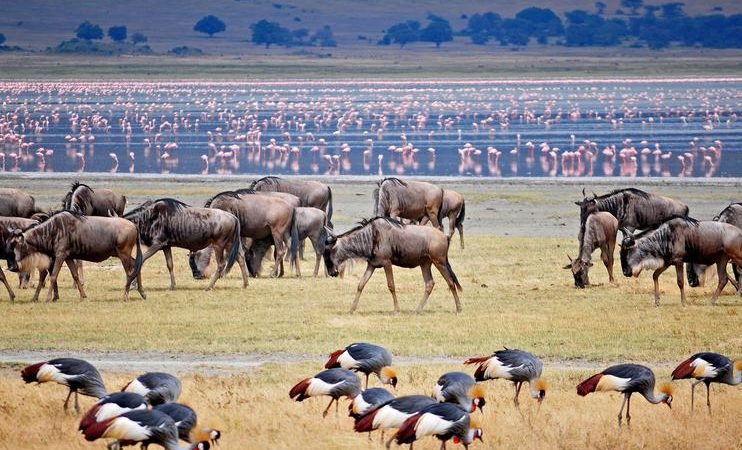
The Tarangire River and its associated swamps provide a permanent water source that draws an impressive array of waterbirds, particularly during the dry season when wildlife concentrates along its banks. Saddle-billed storks, yellow-billed storks, African fish eagles, and various herons and egrets are regularly seen fishing or wading in the shallows. Seasonal pools also attract African jacanas, hamerkops, and migratory waders, adding another dimension to the park's birding diversity beyond its famous dry-country specialists.

🐦

Hornbills & Baobab Nesters

Tarangire's iconic baobab trees are more than a scenic backdrop; their hollow trunks provide vital nesting cavities for a range of hole-nesting species. Von der Decken's hornbills and red-billed hornbills are among the park's most visible birds, often seen foraging in pairs along roadsides. Baobabs and dead acacia snags also host lilac-breasted rollers, d'Arnaud's barbets, and various starlings, while barn owls occasionally roost in cavities during daylight hours, adding an element of surprise to game drives.

🗺

Best Birding Areas & Times

The Tarangire River corridor, Silale Swamp, and the woodland surrounding Tarangire Safari Lodge are consistently the park's most productive birding areas. Early morning game drives yield the highest activity, particularly during the dry season (June-October) when birds concentrate near remaining water sources alongside the park's famous elephant herds. The wet season (November-May) brings migratory species and breeding plumage, offering a different but equally rewarding birding experience for visitors willing to explore beyond the peak season crowds.

Plan Your Tarangire Safari

Trip Length
6 – 15+ days
Comfort Level
Safari Style
Operator Rating
Specialized Tours
Filter by Operator
Other Tour Features

Tarangire Birding: Frequently Asked Questions

How many bird species live in Tarangire National Park?

Tarangire National Park has an official bird checklist of more than 550 species, making it one of the richest birding destinations in Tanzania and the entire Northern Circuit. This diversity stems from the park's varied habitats, which include open acacia savannah, dense baobab woodland, seasonal swamps, and the permanent Tarangire River, each supporting a different community of birds. Species range from dry-country specialists found almost nowhere else in East Africa to migratory waterbirds, raptors, hornbills, and forest dwellers. Because Tarangire remains less visited than the Serengeti or Ngorongoro Crater, birders often enjoy quieter game drives with excellent, consistent sighting opportunities.

What makes Tarangire one of Tanzania's top birding destinations?

Tarangire earns its reputation through an unusual combination of habitats packed into one park: open savannah dotted with iconic baobab trees, dense riverine forest along the Tarangire River, seasonal swamps such as Silale, and dry acacia woodland. This mix supports both dry-country specialists rarely found elsewhere on the Northern Circuit and the raptors, waterbirds, and forest species typical of wetter parks. Unlike the Serengeti, where birding often takes a back seat to the Great Migration, Tarangire rewards focused birdwatching year-round. Lower visitor numbers, permanent water, and exceptional raptor density make it a standout choice for serious and casual birders alike.

What are Tarangire's dry-country bird specialists?

Tarangire is the Northern Circuit's premier location for Tanzania's dry-country bird specialists, species adapted to the arid Maasai Steppe ecosystem and largely absent from wetter parks like the Serengeti. Standout specialists include the yellow-collared lovebird, ashy starling, rufous-tailed weaver, Beesley's lark, and northern pied babbler, several of which are near-endemic to north-central Tanzania. These species thrive in the park's acacia woodland and open grassland rather than forest or wetland habitats. Because Tarangire concentrates so many of these specialists in one easily accessible area, it is frequently recommended to birders who want to complete their East African checklist efficiently and quickly.

Where can I see the yellow-collared lovebird in Tarangire?

The yellow-collared lovebird is one of Tarangire's most photographed birds and is considered a near-guaranteed sighting for visitors. This small, vividly colored parrot is endemic to north-central Tanzania and is commonly seen in noisy flocks around acacia woodland, baobab groves, and areas near water throughout the park. It is especially active and vocal in the early morning and late afternoon, making game drive hours ideal for spotting it. Because the species is so localized geographically, Tarangire is one of the most reliable places in the world to observe yellow-collared lovebirds in their natural habitat without any specialist searching required.

What is special about the ashy starling?

The ashy starling is a plain but highly sought-after bird found almost exclusively in central and northern Tanzania, with Tarangire National Park among the best places on earth to see it. Unlike Tanzania's more colorful starling species, the ashy starling is understated in appearance, but its restricted range makes it a priority target for birders completing regional checklists. It is commonly seen in small flocks moving through acacia woodland and open savannah, often alongside other dry-country specialists such as the yellow-collared lovebird. Its near-endemic status and consistent abundance within the park make Tarangire a key global destination for this species.

Which raptors and birds of prey are found in Tarangire?

Tarangire's open plains and abundant prey base make it one of Tanzania's best raptor-viewing destinations. Martial eagles, tawny eagles, African hawk-eagles, and bateleurs are frequently seen soaring over the savannah or perched in acacia trees, while palm-nut and white-backed vultures circle over carcasses during the dry season. Smaller raptors, including pygmy falcons, gabar goshawks, and dark chanting goshawks, are commonly spotted near termite mounds and roadside perches. The park's high wildlife density, particularly during the dry season, concentrates predators and scavengers alike, giving birders unusually frequent and close raptor sightings compared to other Northern Circuit parks and reserves.

What birds live in the riverine forest along the Tarangire River?

The gallery forest lining the Tarangire River hosts a distinct community of woodland birds not found on the open plains. Silvery-cheeked hornbills, trumpeter hornbills, and African paradise flycatchers move through the canopy, while green wood-hoopoes, black-headed orioles, and various barbets forage in the mid-story. Dense riverside thickets also shelter more secretive species, including the white-browed robin-chat, which is best located by call. Birders exploring the riverbanks on foot or by vehicle, or scanning fig trees during fruiting season, are often rewarded with sightings unavailable elsewhere in the park, making the river corridor an essential stop on any Tarangire birding itinerary.

What waterbirds can be seen along the Tarangire River?

The Tarangire River and its associated swamps provide permanent water that draws a strong concentration of waterbirds, especially during the dry season when wildlife gathers along its banks. Saddle-billed storks, yellow-billed storks, African fish eagles, and multiple heron and egret species are regularly seen fishing or wading in the shallows. Seasonal pools and the Silale Swamp attract African jacanas, hamerkops, and migratory waders during the wet months, adding further variety. This reliable, permanent water source makes the river corridor one of the most productive and consistent birding areas in the entire park, regardless of season or time of year.

Where do hornbills nest in Tarangire National Park?

Tarangire's thousands of ancient baobab trees provide essential nesting cavities for the park's hole-nesting bird species, making baobab groves a top priority for hornbill spotting. Von der Decken's hornbills and red-billed hornbills are among the most visible birds in the park, frequently seen foraging in pairs along roadsides and around lodges. Silvery-cheeked hornbills favor the denser riverine forest instead. Dead acacia snags and baobab hollows also host lilac-breasted rollers, d'Arnaud's barbets, and various starlings, while barn owls and scops owls occasionally roost in daylight cavities, rewarding attentive visitors with an unexpected sighting during an otherwise ordinary game drive.

When is the best time of year to visit Tarangire for birding?

Tarangire offers rewarding birding year-round, but the two seasons deliver different experiences. The dry season, from June to October, concentrates both wildlife and birds around remaining water sources, making raptors, waterbirds, and dry-country specialists easier to locate alongside Tarangire's famous elephant herds. The wet season, from November to May, brings migratory species, breeding plumage, and nesting activity, along with lush green scenery, though some roads can be less accessible. Serious birders often prefer the wet season for variety, while general safari travelers combining birding with game viewing typically favor the dry season's reliable sightings and easier road access.

Can I combine birdwatching with general wildlife game drives in Tarangire?

Yes, Tarangire is exceptionally well suited to combining birding with general wildlife viewing, since the same open savannah, riverine forest, and waterholes that attract elephants, lions, and giraffes also support the park's 550-plus bird species. Experienced guides can identify raptors, hornbills, and dry-country specialists while conducting a standard game drive, without requiring a separate specialist itinerary. This makes Tarangire ideal for mixed groups, where some travelers want dedicated birding time and others prioritize mammals. Foot Slopes Tours and Safaris routinely tailors game drives to balance both interests, ensuring no traveler in the vehicle misses a highlight sighting of any kind.

How does Tarangire compare to the Serengeti for birding?

While the Serengeti offers a longer overall bird list due to its sheer size, Tarangire is widely regarded as the better destination for Tanzania's dry-country specialists, including the yellow-collared lovebird and ashy starling, which are scarce or absent in the Serengeti. Tarangire's baobab woodland, permanent river, and lower visitor numbers also concentrate raptors and waterbirds more predictably. The Serengeti's birding is often secondary to Great Migration viewing, whereas Tarangire allows focused, unhurried birdwatching alongside excellent general game viewing. Many birders combine both parks on one itinerary to maximize total species diversity and sighting quality across the Northern Circuit.

How many days should I spend birding in Tarangire National Park?

Most birders spend two to three full days in Tarangire to comfortably cover its major habitats: the riverine forest, open acacia savannah, baobab woodland, and seasonal swamps such as Silale. This timeframe allows for early morning and late afternoon game drives, when bird activity peaks, plus flexibility to revisit productive areas for target species like the ashy starling or yellow-collared lovebird. Travelers combining birding with general wildlife viewing often extend their stay to four days for a more relaxed pace. Foot Slopes Tours and Safaris can freely adjust itinerary length based on specific target species, budget, and personal priorities.

Why choose Foot Slopes Tours and Safaris for a Tarangire birding safari?

Foot Slopes Tours and Safaris is a locally owned Tanzania safari operator with deep, firsthand knowledge of Tarangire's birding hotspots, from the river corridor to the Silale Swamp and prime baobab woodland. Itineraries are custom-built around each traveler's priorities, whether that means a dedicated birding-focused safari or a general wildlife trip with strong birding components woven in. Guests benefit from experienced local guides, well-maintained vehicles, and flexible scheduling that allows extra time at productive sites when sightings warrant it. This combination of local expertise, flexibility, and genuine care for guest experience is what sets Foot Slopes Tours and Safaris apart.

Do Foot Slopes Tours and Safaris guides have birding expertise?

Yes, Foot Slopes Tours and Safaris guides are trained to identify Tarangire's key bird species, including dry-country specialists like the yellow-collared lovebird and ashy starling, as well as raptors, hornbills, and waterbirds. Guides carry field knowledge built from years of leading drives through the park's varied habitats and stay current on seasonal patterns, breeding activity, migration timing, and reliable sighting locations. For travelers with more advanced birding interests, guides can slow the pace, prioritize quieter routes, and focus on specific target species. This expertise ensures that both casual visitors and dedicated birders alike get a genuinely rewarding, well-informed experience.

Can Foot Slopes Tours and Safaris create a custom Tarangire birding itinerary?

Absolutely. Foot Slopes Tours and Safaris specializes in building custom itineraries around each traveler's interests, and a dedicated Tarangire birding safari can be tailored around target species, preferred habitats, and available time. Options include extended stays near the Tarangire River and Silale Swamp, early-morning and late-afternoon drive scheduling to match peak bird activity, and combinations with other Northern Circuit parks such as the Serengeti or Ngorongoro Crater for a broader species count. Whether planning a short add-on to a general safari or a longer multi-day birding-focused trip, the team designs each itinerary around the traveler's specific goals and interests.

Is Foot Slopes Tours and Safaris a trusted, locally owned Tanzania safari operator?

Yes, Foot Slopes Tours and Safaris is a locally owned and operated Tanzania safari company with an established track record of designing personalized safaris across the Northern Circuit, including Tarangire National Park. The team combines on-the-ground knowledge of the region's parks, seasons, and wildlife patterns with genuine, responsive customer service throughout the planning process and the trip itself. Guests consistently highlight knowledgeable guides, well-planned itineraries, and attentive support as reasons for recommending the company. This local ownership and hands-on approach give travelers real confidence that their Tarangire birding safari will be expertly planned and smoothly executed from start to finish.

Plan With Confidence

Plan Your Tarangire Birding

Tell us your dates, style, and preferred parks, and we will build the perfect itinerary around you.

Book Now Online →

What Our Travelers Say

Real 5-star reviews from guests who traveled with us

“
★★★★★

Our Private African luxury Safari experience with Foot Slopes Tours and Safaris was nothing short of exceptional. From the very beginning, owner Gabriel was incredibly responsive, making the entire booking process smooth and stress-free. Gabriel went above and

Charlotte T
“
★★★★★

We had an incredible private safari experience with Foot Slopes Tours and Safaris. Their office staff was very helpful and informative, and they communicated very well. Our pick-ups to and from the airport were on time and hassle-free, an unforgettable Safari

Evans Aiden
“
★★★★★

Foot Slopes Tours and Safaris is truly one of the best local tour companies in Tanzania. From start to finish, their service was professional, reliable, and personalized. The team went above and beyond to make sure every detail of our trip was perfect. Our saf

André T
“
★★★★★

Our family chose Foot Slopes Tours and Safaris for a custom 11-day safari itinerary, and we couldn’t be happier with our choice! Everything from our initial inquiry to building our custom itinerary to pre-departure and on-trip support was top quality. Communic

Ida N