Fastest Animals in the World
Fastest Animals in the World
Speed is one of nature’s most fascinating survival tools. In the animal kingdom, it’s the difference between life and death — the key to catching prey or escaping danger. Across the world’s savannas, grasslands, deserts, and forests, a few extraordinary creatures have evolved to move at breathtaking velocities. From the Cheetah’s explosive sprint to the Pronghorn’s long-distance endurance, these are the fastest animals in the world, built for pure, raw power and precision. The fastest animals in the world are the peregrine falcon in a dive (up to 242 mph), the cheetah on land (up to 75 mph), and the black marlin in water (up to 80 mph). The pronghorn antelope is the fastest long-distance runner on land.
The top 10 fastest animals are the Peregrine Falcon (diving speed), White-throated Needletail Swift (level flight), Black Marlin (water), Mexican Free-tailed Bat (flight), Cheetah (land), Sailfish (water), Pronghorn (land), Marlin (water), Springbok (land), and Lion (land). The peregrine falcon is the fastest animal overall, reaching over 240 mph when diving.
Cheetah – Top Speed: 75 mph (121 kph)
The Cheetah (Acinonyx jubatus) stands as the undisputed fastest land animal on Earth. Found mainly in Africa’s open plains and savannas, the cheetah’s body is perfectly adapted for speed. Its lightweight frame, elongated limbs, and flexible spine allow it to stretch its body like a coiled spring during each stride. Within seconds, it can accelerate from 0 to 60 mph (96 kph) — faster than most sports cars. This burst of energy, however, is short-lived, lasting only 20 to 30 seconds. The cheetah relies on these incredible sprints to chase down antelopes such as gazelles or impalas. Its semi-retractable claws provide grip, while large nasal passages and lungs supply oxygen to its powerful muscles. The cheetah isn’t just fast — it’s a masterpiece of evolution designed for speed.
Pronghorn Antelope – Top Speed: 55 mph (89 kph)
North America’s Pronghorn Antelope (Antilocapra americana) takes the silver medal in the speed race. Although it can’t match the cheetah’s explosive acceleration, it is the fastest long-distance runner in the animal world. A pronghorn can hold around 45 mph (72 kph) for about a kilometer and cruise at roughly 30 mph (48 kph) for several kilometers — an ability unmatched by any other land mammal. Its large heart and lungs support this endurance, while its light, aerodynamic build and long legs allow for efficient strides. Scientists believe the pronghorn evolved this exceptional speed to escape predators that no longer exist — such as the extinct American cheetah. Today, the pronghorn still reigns supreme across the North American plains, a living relic of a faster, more dangerous past.
Springbok – Top Speed: 55 mph (89 kph)
The Springbok (Antidorcas marsupialis), native to southern Africa, shares its speed record with the pronghorn. Agile and graceful, this gazelle-like antelope uses its velocity and unique leaping behavior, known as pronking, to evade predators like cheetahs and lions. With each bound, the springbok can rise up to two meters into the air, an act that confuses attackers and showcases its strength. Its slender legs, strong muscles, and elastic tendons store and release energy efficiently, making it both fast and nimble. Whether sprinting across the Kalahari or bounding through the grasslands, the springbok’s speed is a dazzling display of survival through agility.
Wildebeest – Top Speed: 50 mph (80 kph)
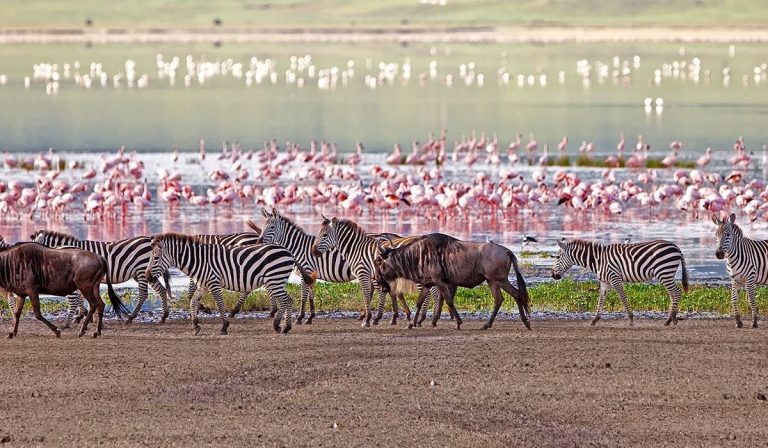
The Wildebeest (Connochaetes taurinus), famous for its role in the Great Migration across Tanzania’s Serengeti and Kenya’s Maasai Mara, is another powerhouse of speed. Capable of reaching 50 mph (80 kph), wildebeests rely on their endurance and group coordination to outmaneuver predators. Their muscular build, long legs, and sturdy hooves allow them to gallop across rugged terrains in massive herds. Despite their seemingly clumsy appearance, wildebeests can sprint with astonishing agility when chased by lions, cheetahs, or hyenas. Their speed, combined with sheer numbers, ensures survival during their perilous annual journey.
A general guide: the herds follow the rains.
Lion – Top Speed: 50 mph (80 kph)
The Lion (Panthera leo) — the king of the jungle — may not be the fastest sprinter overall, but its burst speed is formidable. Lions can reach up to 50 mph (80 kph) over short distances while hunting. Their power lies in muscular strength and explosive acceleration, not endurance. A lion’s hunting strategy depends on stealth and teamwork. They stalk prey silently, getting as close as possible before launching a short, high-speed ambush. Despite their size and weight, lions are agile predators, capable of bringing down massive animals like buffaloes, wildebeests, and even young elephants.
Blackbuck – Top Speed: 50 mph (80 kph)
The Blackbuck (Antilope cervicapra), native to the Indian subcontinent, is known for its elegance and lightning speed. Reaching speeds of 50 mph (80 kph), this antelope uses its agility to escape predators such as leopards and wolves. Its spiral horns, slender legs, and light body make it a symbol of grace and power in motion. In open grasslands, the blackbuck’s speed becomes its greatest defense. Even when running, it can twist and turn rapidly — a maneuver that often saves its life in the wild.
American Quarter Horse – Top Speed: 47.5 mph (76.5 kph)
Among domesticated animals, the American Quarter Horse reigns supreme. Famous for short-distance sprinting, it can reach 47.5 mph (76.5 kph), especially over a quarter-mile stretch — hence the name “Quarter Horse.” Built with strong hindquarters, broad chests, and well-developed muscles, this breed is favored in rodeo events, barrel racing, and ranch work. Its combination of speed, balance, and agility makes it one of the most versatile horse breeds in the world.
Brown Hare – Top Speed: 45 mph (72 kph)
The Brown Hare (Lepus europaeus) is a master of escape. Reaching speeds up to 45 mph (72 kph), it uses zigzag running patterns to outsmart predators like foxes and birds of prey. Unlike rabbits, hares live above ground and rely solely on their legs for survival. With long hind limbs and powerful muscles, the brown hare can leap great distances in seconds. Its keen eyesight helps it detect threats from far away, giving it a split-second advantage that often means the difference between life and death.
Greyhound – Top Speed: 43 mph (69 kph)
The Greyhound, renowned as the fastest dog breed, can sprint up to 43 mph (69 kph). Its slim physique, deep chest, and flexible spine mirror those of the cheetah, allowing for incredible acceleration and smooth strides. Originally bred for hunting and racing, greyhounds are both athletes and companions. Their aerodynamic design and high muscle-to-fat ratio make them natural sprinters, dominating the world of dog racing and earning their title as “canine speed champions.”
Kangaroo – Top Speed: 44 mph (71 kph)
The Kangaroo, Australia’s iconic marsupial, can reach 44 mph (71 kph) in short bursts. What makes it fascinating is its unique mode of movement — hopping. Using powerful hind legs and a long, muscular tail for balance, kangaroos conserve energy by bouncing across open terrain. Their tendons act like elastic springs, storing and releasing energy efficiently with each hop. This allows kangaroos not just to move fast, but to do so economically, covering long distances with minimal effort.
Coyote – Top Speed: 43 mph (69 kph)
The Coyote (Canis latrans) is one of North America’s most adaptable predators. With a top speed of 43 mph (69 kph), it uses speed and strategy to hunt small mammals and birds. Coyotes are not just sprinters — they’re marathon hunters capable of maintaining high speeds for extended chases. Their lean build, sharp reflexes, and endurance make them formidable survivors across deserts, forests, and urban environments alike.
African Wild Dog – Top Speed: 42 mph (68 kph)
The African Wild Dog (Lycaon pictus), also known as the painted wolf, is one of Africa’s most successful hunters. Capable of speeds up to 42 mph (68 kph), its real strength lies in stamina and teamwork. Hunting in coordinated packs, wild dogs can maintain high-speed pursuits for several kilometers, often with a success rate of over 80%. Their slim build, long legs, and powerful lungs make them endurance athletes of the savanna.
Jackal – Top Speed: 40 mph (64 kph)
The Jackal may be small, but it’s impressively fast, reaching up to 40 mph (64 kph). Agile and cunning, jackals use their speed to scavenge or steal food and to escape larger predators. Their compact bodies, keen senses, and adaptable behavior make them expert survivors in Africa and Asia’s harsh environments. They rely on both speed and strategy, often working in pairs or small family groups.
Ostrich – Top Speed: 40 mph (64 kph)
The Ostrich (Struthio camelus) is the fastest-running bird in the world, capable of reaching 40 mph (64 kph). Native to Africa, this flightless bird compensates for its inability to fly with astonishing running power. Its long, muscular legs can cover up to 16 feet (5 meters) in a single stride. With strong thighs and two-toed feet built for traction, the ostrich can maintain steady speeds for long distances, outrunning most predators with ease.
Elk – Top Speed: 40 mph (64 kph)
The Elk (Cervus canadensis), one of the largest members of the deer family, can reach speeds of 40 mph (64 kph). Despite their size, elks are remarkably agile and rely on this speed to escape wolves and bears. Their long, muscular legs and powerful lungs make them adept at sprinting through forests and mountainous terrain. During mating season, their speed and stamina also play a role in dominance battles and territorial defense.
Fastest animal in the water
The fastest animal in the water is the black marlin, which can reach speeds of up to 82 mph (132 km/h). The sailfish is also frequently cited as the fastest, with speeds reaching approximately 68 mph (109 km/h). Black Marlin: Reaching speeds up to 82 mph (132 km/h), it is considered the fastest by many sources. Sailfish: Often mentioned as the fastest, with reported speeds around 68 mph (109 km/h). Swordfish: The third-fastest, with speeds up to 60 mph (97 km/h).
The fastest underwater animal is the Black Marlin, capable of speeds up to 82 mph, followed by the Sailfish at 68 mph and the Swordfish at 60 mph. Other fast animals include the Yellowfin Tuna (50 mph), the Pilot Whale (47 mph), and the Atlantic Bluefin Tuna (43 mph).
What is the second fastest animal in the world?
The second fastest animal in the world is usually given as the golden eagle, which can reach around 150–200 mph (240–320 km/h) in a hunting dive. If considering only land animals, the pronghorn is the second fastest, though the cheetah is slightly faster in short bursts. The fastest animal on land is the cheetah, and the fastest animal in water is the black marlin. The cheetah can reach speeds of up to about 120 km/h (75 mph), while the black marlin can reach speeds of up to 132 km/h (82 mph).
Which is faster, sailfish or black marlin?
Both are often named the ocean’s fastest fish, and the answer is debated. Sailfish are reliably recorded at around 68 mph (110 kph), while some sources report black marlin bursts of about 80 mph (129 kph), a figure that has not been confirmed in controlled studies. Both are extraordinary ocean predators, built for speed with sleek, muscular bodies and long bills for hunting. The black marlin is larger and more powerful, while the sailfish is renowned for its agility and lightning-fast pursuits.
Fastest Animals in the Sea vs Fastest Animals in the World (on Land)
One of the fastest animals in the sea, the sailfish, can reach speeds of 68 mph (110 kph), while the fastest animal on land, the cheetah, sprints up to 75 mph (121 kph). Both are masters of speed, adapted perfectly to their environments — the sailfish slicing through water with its streamlined body, and the cheetah accelerating across savannas with explosive power. Together, they represent nature’s ultimate balance of agility, strength, and precision in motion.
What is the Fastest Ocean Animal in the World?
The sailfish is widely regarded as one of the fastest ocean animals in the world, capable of reaching speeds up to 68 mph (110 kph). Recognized by its striking sail-like dorsal fin and long, pointed bill, the sailfish uses its incredible speed and agility to hunt schools of smaller fish. Found in both the Atlantic and Indo-Pacific Oceans, this magnificent predator embodies the power and grace of the open sea, making it a true marvel of marine evolution.
What are the fastest birds in the world?
The bird that can achieve the greatest airspeed is the peregrine falcon (Falco peregrinus), able to exceed 320 km/h (200 mph) in its dives. This makes it the fastest animal on Earth, although the White-throated Needle-tail is the fastest in level flight. Ostriches are crazy fast! They're actually the fastest-running birds on Earth. They can reach top speeds of about 37–43 mph. Each stride can be up to 16 feet long when they're in full sprint.
The fastest animal in the air is the peregrine falcon, which can reach speeds of over 240 mph (389 km/h) in a hunting dive or "stoop". This remarkable speed is achieved through its aerodynamic body, lightweight structure, and unique adaptations for high-speed maneuvering. The peregrine falcon is the fastest animal on Earth, with top speeds of over 242 mph (389 km/h) recorded during its hunting dive. Its body is streamlined, and it has unique respiratory features that protect its lungs during high-speed dives.
Golden eagle: The second fastest, with a diving speed of up to 200 mph (322 km/h). Saker falcon: Comes in third, with a diving speed of up to 198 mph (319 km/h). White-throated needletail: This bird is believed to be the fastest in level flight, reaching speeds of around 105 mph (170 km/h). Brazilian free-tailed bat: This bat holds the record for the fastest horizontal flight among mammals, reaching speeds of up to 100 mph (160 km/h).
Antelope vs Gazelle: Features, Speed & Size, Comparison, difference, Adaptations
How Fast Can an Antelope Run? (Antelope Top Speed in Km/h)
17 Amazing Facts About Tanzania (Truly Amazing)
Cheetah vs Leopard: What’s the Difference?
10 Fascinating Facts About African Big Cats
Are you looking to plan an African Safari vacation?
To plan an African safari vacation, start by deciding on your budget, desired destinations, and the time of year you want to travel. Next, research tour companies, consider booking flights and accommodation in advance, and prepare necessary documents like visas and vaccinations. Finally, pack appropriate gear, including lightweight clothing, a good camera, and sun protection, and be flexible as experiences are customizable. We design authentic, private, tailor-made safaris for families with kids, honeymooners and couples, and seniors.
- ArushaGateway
- TarangireElephants
- NgorongoroCrater
- SerengetiBig Five
- ZanzibarBeach
Conclusion: The Power of Speed in the Wild
From the cheetah’s lightning sprint to the pronghorn’s unmatched endurance, these animals showcase nature’s incredible engineering. Each one has evolved a unique combination of muscle power, aerodynamic design, and instinct that allows it to move faster than most humans can imagine. Speed is not just about velocity — it’s about survival, precision, and the timeless race between predator and prey.
Fastest Animals in the World: FAQs
What is the fastest land animal?
The cheetah is the fastest land animal, reaching sprint speeds of around 100–120 km/h in short bursts. It accelerates incredibly quickly thanks to its lightweight body, flexible spine and long tail for balance. Tanzania’s Serengeti is one of the best places in the world to watch cheetahs hunt.
How fast can a lion run?
A lion can reach about 80 km/h in short bursts, but it tires quickly, so it relies on stealth and teamwork to get close to prey before charging. Lionesses usually do most of the hunting, often working together to ambush zebras, wildebeest and other animals.
Where can I see cheetahs in Tanzania?
The open plains of the Serengeti, especially the southern Serengeti and Ndutu area, are among the best places in Africa to see cheetahs. They hunt by day on the short-grass plains, making them easier to spot than leopards. The Ngorongoro Crater and Tarangire also offer sightings.
What animals can I see on a Tanzania safari?
A Tanzania safari offers the Big Five, plus cheetahs, giraffes, zebras, wildebeest, hippos, hyenas, wild dogs in some parks and hundreds of bird species. The Serengeti is famous for predators and the Great Migration, Tarangire for elephants and the Ngorongoro Crater for black rhinos.
Is Tanzania safe for a safari?
Tanzania is generally regarded as one of Africa’s safest safari destinations when you travel with a reputable operator. Follow your guide’s instructions, stay in the vehicle during game drives and never approach wildlife. Keep valuables secure in towns, check current travel advice before departure and carry comprehensive travel insurance for peace of mind.
Can I combine a safari with Zanzibar?
Yes, a Tanzania safari followed by Zanzibar is one of Africa’s most popular holidays. After game drives in the Serengeti, Ngorongoro or Tarangire, a short flight takes you to Zanzibar for white-sand beaches, snorkelling, dhow cruises, spice tours and historic Stone Town. Plan three to five nights on the island to relax after your safari.
How much does a Tanzania safari cost?
Safari costs depend on the season, accommodation level, safari length, park fees and whether you travel privately. Budget camping safaris cost the least, while mid-range lodges and luxury tented camps cost more but add comfort and personal service. Request a detailed quotation listing inclusions and exclusions so you can compare value rather than headline prices.
What is the Great Migration?
The Great Migration is the year-round movement of more than a million wildebeest, with zebras and gazelles, around the Serengeti ecosystem in search of fresh grazing. Calving takes place in the southern Serengeti from January to March, the herds move west around June and July, and dramatic Mara River crossings occur in the north from about August to October.
See Africa’s Wildlife Up Close
Tell us which animals you dream of seeing, and we will design a private tailor-made safari to the right parks at the right time.