Lake Natron itself is one of the most hostile environments for wildlife on Earth. Fed by mineral-rich hot springs and volcanic ash from Ol Doinyo Lengai, its shallow waters reach a pH between 9 and 10.5, caustic enough to calcify birds that die on its shores and to keep fish, crocodiles, and virtually every large mammal out of the water entirely. That same hostility is exactly why Lake Natron matters: it is the primary breeding ground for up to 2.5 million of East Africa's lesser flamingos, who nest undisturbed on temporary salt islands beyond the reach of predators. Around the lake, the picture changes. Dry acacia and Commiphora bush, seasonal wetlands, and the dramatic Rift Valley escarpment support grazing gazelle and zebra, passing wildebeest, spotted hyena, jackal, and Maasai cattle. Lake Natron is not a Big Five game-drive destination — wildlife here is a supporting act to the flamingo spectacle, the active volcano, and the Engare Sero waterfalls.
The caustic lake keeps most animals away — but the surrounding bush, escarpment, and salt flats tell a different story.
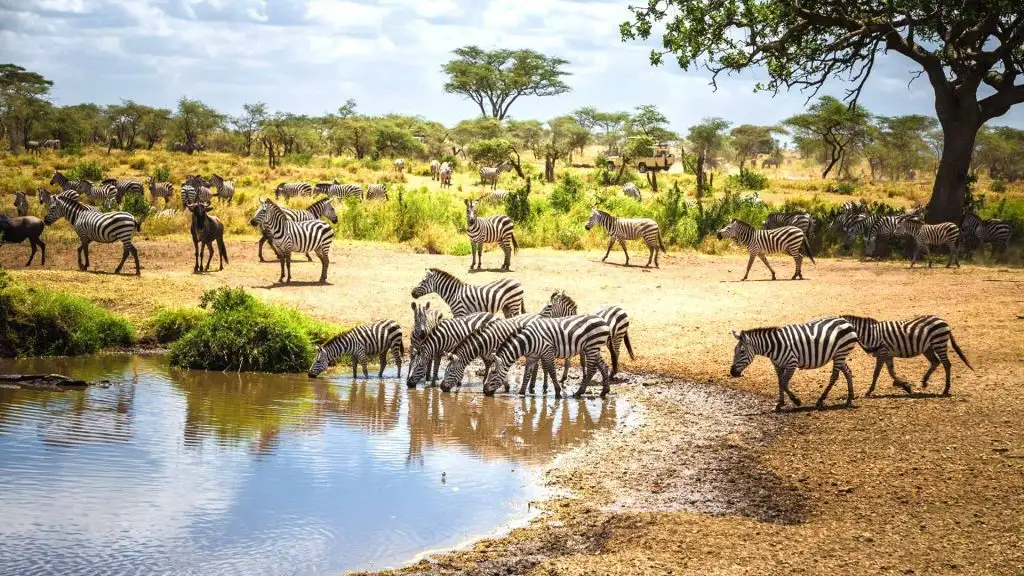
Grant's and Thomson's gazelle graze the dry, thorn-scrub plains that ring Lake Natron, joined by scattered herds of Burchell's zebra moving between seasonal grazing grounds. Wildebeest occasionally pass through on the fringes of the wider Rift Valley ecosystem, though numbers are modest compared to the Serengeti itself. Sightings are opportunistic, best combined with a guided walk or drive along the lake's southern and western margins in the early morning or late afternoon.
Spotted hyena clans and black-backed jackal are the most consistent predators around Lake Natron, denning in the acacia bush and rocky outcrops of the escarpment and patrolling the lakeshore for stranded fish-eagle prey and weakened flamingo chicks. Their calls carry across the open plains at dusk, often the first sign of wildlife activity after a day spent among the salt flats and hot springs. Sightings are best on guided evening walks with a local Maasai guide.
Maasai communities have grazed cattle, goats, and donkeys across the Natron basin for generations, and livestock herds remain a defining sight on the drive in and around the lake. Sharing pasture with wild gazelle and zebra, these herds are part of a living pastoral landscape rather than a fenced park. Visitors regularly pass Maasai bomas and herders moving stock to water, adding a cultural dimension found nowhere in Tanzania's fenced national parks.
Lake Natron's water carries a pH as high as 10.5, fed by sodium- and mineral-rich hot springs and volcanic ash from nearby Ol Doinyo Lengai. This alkalinity is caustic enough to burn skin and eyes on contact and to prevent virtually all fish, crocodiles, and mammals from entering the lake itself. Only a single hardy species, the alkaline tilapia, survives in the cooler spring-fed margins — everything else stays on dry land.
The crusted salt flats and surrounding scrubland host agama lizards, monitor lizards, and several snake species adapted to extreme heat and mineral-rich soil, though reptile sightings are incidental rather than a trip focus. More striking than the animals themselves is the terrain: sun-baked mineral crusts, red-tinted algae blooms, and mirror-flat evaporation pans that make the lakebed itself one of the most otherworldly landscapes in the Rift Valley.
The Engare Sero waterfalls and the escarpment trails above the lake offer the best chance of combining scenery with wildlife, where gazelle and zebra graze near freshwater streams. Many travelers pair Lake Natron with a short extension into Ngorongoro Conservation Area or the southern Serengeti, less than a day's drive away, to add Big Five sightings and the wildebeest migration to the volcanic and ornithological highlights of Natron itself.
Hand-picked Northern Circuit itineraries that combine easily with Lake Natron, tailored privately by Foot Slopes Tours and Safaris.

A six-day Serengeti and Ngorongoro combination built for multi-generation travelers.
View Package →
An eight-day tour across Tanzania's top northern circuit parks.
View Package →
A nine-day fully private safari through Tanzania's northern circuit highlights.
View Package →
A ten-day journey across Tanzania's most celebrated northern parks.
View Package →
Ten days combining the very best of the northern safari circuit.
View Package →
Ten days of ultra-luxury lodges across Tanzania's premier parks.
View Package →
An eight-day luxury safari focused on spotting Africa's Big Five.
View Package →
A seven-day safari highlighting the very best of the Serengeti ecosystem.
View Package →Lake Natron is not a Big Five destination, so expect a different mix of wildlife than the Serengeti or Ngorongoro. The main draw is up to 2.5 million lesser flamingos, which breed on the lake's caustic salt islands where predators cannot follow. Around the shoreline and surrounding acacia and Commiphora bush, you can spot Grant's and Thomson's gazelle, Burchell's zebra, passing wildebeest, spotted hyena, and black-backed jackal, alongside Maasai cattle and goats. Reptiles such as agama and monitor lizards inhabit the salt flats. Wildlife viewing here is secondary to the flamingo spectacle, Ol Doinyo Lengai volcano, and Engare Sero waterfalls.
Lake Natron sits in a shallow basin fed by mineral-rich hot springs and volcanic ash washed down from nearby Ol Doinyo Lengai, the "Mountain of God," whose carbonatite lava is rich in sodium and potassium carbonate. Evaporation under the sun concentrates these minerals until the lake's pH reaches between 9 and 10.5, similar to ammonia. This causticity can burn the skin and eyes of unadapted animals and is strong enough to calcify the bodies of birds that die on the shoreline. It is this hostility that keeps predators and fish away, making the lake a safe flamingo breeding ground.
Almost none. Lake Natron's high alkalinity and temperatures, which can exceed 60 degrees Celsius near the hot springs, make the main body of the lake uninhabitable for crocodiles, hippos, and nearly all fish species found elsewhere in East Africa. The one exception is the alkaline tilapia, a hardy fish that survives only in cooler, less caustic freshwater inflows where streams enter the lake. This near-total absence of aquatic predators is precisely why flamingos choose Lake Natron over freshwater lakes nearby: there is nothing in the water capable of threatening their eggs, chicks, or nesting colonies on the exposed salt islands.
Very few animals drink directly from or wade into Lake Natron itself, since its high pH and near-boiling temperatures near the hot springs make prolonged contact dangerous for most mammals and birds. Flamingos are a striking exception, having evolved thick-skinned, scaled legs that tolerate the caustic water while they filter-feed on the cyanobacteria and algae that color the lake pink and red. Most other wildlife, including gazelle, zebra, and Maasai livestock, instead rely on freshwater streams, springs, and seasonal wetlands feeding into the basin from the surrounding hills and escarpment, rather than the alkaline lake surface, for daily drinking water.
Spotted hyena and black-backed jackal are the most commonly encountered predators around Lake Natron, denning in the dry acacia bush, rocky outcrops, and escarpment slopes that ring the lake basin. They patrol the shoreline opportunistically, particularly around weakened flamingo chicks and other stranded birds, and are most active and easiest to spot at dusk and dawn on a guided walk. Larger predators such as lion and leopard are occasionally reported passing through the wider ecosystem but are rare and not a reliable sighting. Predator density here is far lower and less concentrated than in the Serengeti or Ngorongoro Crater.
Yes, in modest numbers. Grant's and Thomson's gazelle graze the dry plains and acacia scrub surrounding Lake Natron year-round, and small herds of Burchell's zebra move through the same grazing grounds between seasonal water sources. Wildebeest are seen less predictably, passing through the margins of the wider Rift Valley ecosystem in small, scattered numbers rather than forming the very large resident herds found much further west. Sightings are opportunistic rather than guaranteed and are best combined with a guided walk or vehicle drive along the lake's southern and western edges during the cooler early morning and late afternoon hours.
No. Lake Natron is not classified or marketed as a Big Five park, and it is not managed or gazetted as a traditional game-drive reserve like the Serengeti. Its ecosystem, dominated by caustic alkaline water, cracked salt flats, and dry acacia bush, does not support dense resident populations of lion, leopard, rhino, elephant, or buffalo. Visitors come primarily for the flamingo breeding spectacle, the active Ol Doinyo Lengai volcano, the Engare Sero waterfalls, and dramatic Rift Valley escarpment scenery, with modest sightings of gazelle, zebra, hyena, and jackal treated as a secondary, incidental feature rather than the trip's main attraction.
Yes, and it is one of the most popular ways to experience northern Tanzania in full. Lake Natron sits within a day's drive of Ngorongoro Conservation Area and the southern Serengeti, both dense with Big Five wildlife and, seasonally, the wildebeest migration and calving herds. Most well-designed itineraries pair two or three nights at Lake Natron, focused on flamingos, the volcano, and waterfalls, with several additional days of classic game drives through Ngorongoro Crater and the Serengeti plains, giving travelers both the rare geological and ornithological spectacle and dense Big Five sightings within one seamless, well-paced northern circuit safari trip.
The single biggest wildlife draw is the lesser flamingo. Up to 2.5 million birds, roughly three-quarters of the world's entire population, breed on Lake Natron's temporary salt islands, making it East Africa's single most important flamingo nesting site by a wide margin. The lake's caustic water keeps land predators away from the islands, allowing colonies to hatch and raise chicks largely undisturbed each season. Combined with views of Ol Doinyo Lengai, the active volcano considered sacred by the Maasai, and the nearby Engare Sero waterfalls, the flamingo spectacle is the reason most travelers visit rather than land-based game viewing alone.
The steep Rift Valley escarpment above Lake Natron supports a noticeably different habitat than the salt flats below, with denser vegetation, seasonal streams, and cooler temperatures at higher elevation. Klipspringer and other small antelope favor the rocky slopes, while gazelle and zebra graze the grassier terrain at the escarpment's base near the lakeshore. Spotted hyena and jackal den in caves and thickets along the escarpment face, and raptors including augur buzzards and several eagle species nest on the cliffs above. The escarpment hiking trails also offer some of the finest panoramic viewpoints over the lake, salt flats, and distant volcano.
Yes, very commonly, and it is part of what makes a visit distinctive. Maasai communities have grazed cattle, goats, and donkeys across the Lake Natron basin for many generations, and livestock herds remain a defining, everyday feature of the landscape today. Because the area is not a fenced national park, wildlife and domestic animals routinely share the same pasture and water points, and visitors regularly pass Maasai bomas, herders on foot, and stock moving toward water along the roads and trails. This living pastoral culture, largely absent from Tanzania's fenced parks, adds a cultural dimension to any Lake Natron visit.
The crusted salt flats and surrounding dry scrubland around Lake Natron host agama lizards, monitor lizards, and several snake species adapted to extreme heat, high salinity, and mineral-rich soil, though reptile sightings are incidental rather than a primary trip highlight for most visitors. More striking than the animals themselves is the terrain itself: sun-baked white and pink mineral crusts, algae-tinted shallow water, and mirror-flat seasonal evaporation pans that together make the lakebed one of the most genuinely otherworldly landscapes found anywhere in the entire Rift Valley region, best explored slowly on a short guided walk wearing closed, sturdy shoes.
Lake Natron offers far fewer and less predictable large-mammal sightings than the Serengeti or Ngorongoro Crater, both dense ecosystems built around large resident predator and prey populations across open grassland. Natron's value lies elsewhere entirely: the lesser flamingo breeding spectacle, active ongoing volcanism at Ol Doinyo Lengai, and dramatic salt-flat and escarpment scenery found nowhere else in all of Tanzania. Most experienced travelers and guides therefore treat Lake Natron as a geological and ornithological add-on to a Big Five circuit rather than a replacement for it, combining both destinations together for a complete and well-rounded northern Tanzania safari itinerary overall.
Foot Slopes Tours and Safaris is a locally based Tanzania operator with direct, on-the-ground experience running the remote roads, guided walks, and long-standing Maasai community relationships that a well-run Lake Natron trip genuinely depends on. Our itineraries are built around the flamingo breeding calendar, Ol Doinyo Lengai access windows, and Engare Sero waterfall conditions, not generic templates copied between destinations, and every trip is carefully planned by guides who know this specific terrain personally and firsthand. We combine Lake Natron seamlessly with Ngorongoro and Serengeti game drives for travelers who want both the flamingo spectacle and the classic Big Five.
Yes. Foot Slopes Tours and Safaris is a licensed, Tanzania-based tour operator with its own local guides, vehicles, and camp partnerships, rather than a foreign reseller working through layers of intermediaries. Being locally based means faster problem-solving on remote routes like Lake Natron, direct relationships with Maasai communities and conservation area authorities, and fair pricing without extra broker markups. Our team lives and works permanently in the destinations we sell, giving firsthand, current knowledge of road conditions, flamingo breeding activity, and seasonal access that a distant overseas agency simply cannot match for a logistically demanding region like Lake Natron.
Yes. Every Lake Natron itinerary is led by experienced local guides specifically trained in the region's terrain, the safety considerations around the caustic lake and salt flats, and the waterfall and escarpment walks that require careful, sure footing underfoot. Many of our guides have personal, longstanding ties to Maasai communities within the Natron basin, adding cultural context and access unavailable from generic tour scripts elsewhere. This local expertise matters most in a destination like Lake Natron, where road conditions, hot-spring hazards, and flamingo breeding activity change with the seasons and reward firsthand, current knowledge over a fixed, one-size-fits-all itinerary.
Yes. Foot Slopes Tours and Safaris builds fully customizable itineraries that combine Lake Natron with Ngorongoro Crater, the Serengeti, Tarangire, or other northern circuit parks, carefully adjusting the balance of flamingo viewing, volcano access, waterfall hikes, and Big Five game drives to match each individual traveler's personal interests, budget, and travel dates. Whether you want a short two-night Lake Natron add-on or a full two-week northern Tanzania journey, our experienced local team designs the route, pacing, and accommodation level around you rather than fitting you into a fixed package, with direct, responsive support throughout every single stage of the trip.
Tell us your dates, style, and preferred parks, and we will build the perfect itinerary around you.
Book Now Online →Real 5-star reviews from guests who traveled with us
Our Private African luxury Safari experience with Foot Slopes Tours and Safaris was nothing short of exceptional. From the very beginning, owner Gabriel was incredibly responsive, making the entire booking process smooth and stress-free. Gabriel went above and
We had an incredible private safari experience with Foot Slopes Tours and Safaris. Their office staff was very helpful and informative, and they communicated very well. Our pick-ups to and from the airport were on time and hassle-free, an unforgettable Safari
Foot Slopes Tours and Safaris is truly one of the best local tour companies in Tanzania. From start to finish, their service was professional, reliable, and personalized. The team went above and beyond to make sure every detail of our trip was perfect. Our saf
Our family chose Foot Slopes Tours and Safaris for a custom 11-day safari itinerary, and we couldn’t be happier with our choice! Everything from our initial inquiry to building our custom itinerary to pre-departure and on-trip support was top quality. Communic