Why Kilimanjaro Is a Natural Wonder: Height, Glaciers, Ecosystems and Culture
Why Kilimanjaro Is a Natural Wonder
Mount Kilimanjaro is considered a natural wonder due to its status as the highest mountain in Africa and the world's tallest free-standing mountain, its unique and diverse ecosystems ranging from tropical rainforests to arctic summit zones, and the rare phenomenon of a snow-capped peak near the equator. Its sheer scale, isolation above surrounding plains, and incredible biodiversity contribute to its designation as a superlative natural phenomenon. Rising majestically from the plains of East Africa, Mount Kilimanjaro is more than just Africa's highest peak; it is a profound testament to the Earth's geological prowess and biological diversity, an undeniable natural wonder. Its snow-capped summit, seemingly defying its equatorial location, beckons adventurers and scientists alike, offering a unique blend of ecological marvels, geological narratives, and deep-rooted cultural significance.
Kilimanjaro’s Height and Isolation: A Solitary Giant
Kilimanjaro's most striking feature is its sheer scale and magnificent isolation. Standing at an impressive 5,895 meters (19,341 feet) above sea level, it is the highest freestanding mountain in the world. Unlike mountain ranges that are part of a continuous chain, Kilimanjaro erupts from the flat plains in splendid solitude. This isolation accentuates its colossal presence, making it a landmark visible from vast distances and creating its own localized weather patterns and ecological zones. It is the highest mountain in Africa (Uhuru Peak at 5,895 meters or 19,341 feet) and the tallest free-standing mountain globally, rising dramatically from the surrounding plains. This grand isolation also plays a crucial role in the evolution of its unique flora and fauna, as species have adapted to the distinct conditions found on its slopes, often developing endemic traits not found anywhere else.
Kilimanjaro’s Diverse Ecosystems: A Vertical Safari
Ascending Kilimanjaro is akin to traversing an entire continent's worth of ecosystems in a single journey. The mountain boasts an astonishing array of climatic zones, each supporting a distinct community of life. The journey begins in the cultivated lower slopes, giving way to lush rainforests teeming with diverse plant and animal life, including various monkey species and elusive leopards. Above the forest, a heath and moorland zone emerges, characterized by giant heathers and unique wildflowers. Higher still, the landscape transforms into an alpine desert, stark and beautiful, with sparse vegetation adapted to extreme conditions. Finally, the summit rears its head, a frigid arctic zone capped with glaciers and snow, a truly surreal experience at the equator. This vertical stratification of ecosystems, compressed into a single mountain, offers an unparalleled opportunity to observe ecological succession and adaptation in real-time.
- Cultivation~800–1,800 m
- Rainforest~1,800–2,800 m
- Heath & moorland~2,800–4,000 m
- Alpine desert~4,000–5,000 m
- Arctic summit~5,000–5,895 m
Kilimanjaro’s Near-Equator Snow Cap: A Paradox of Nature
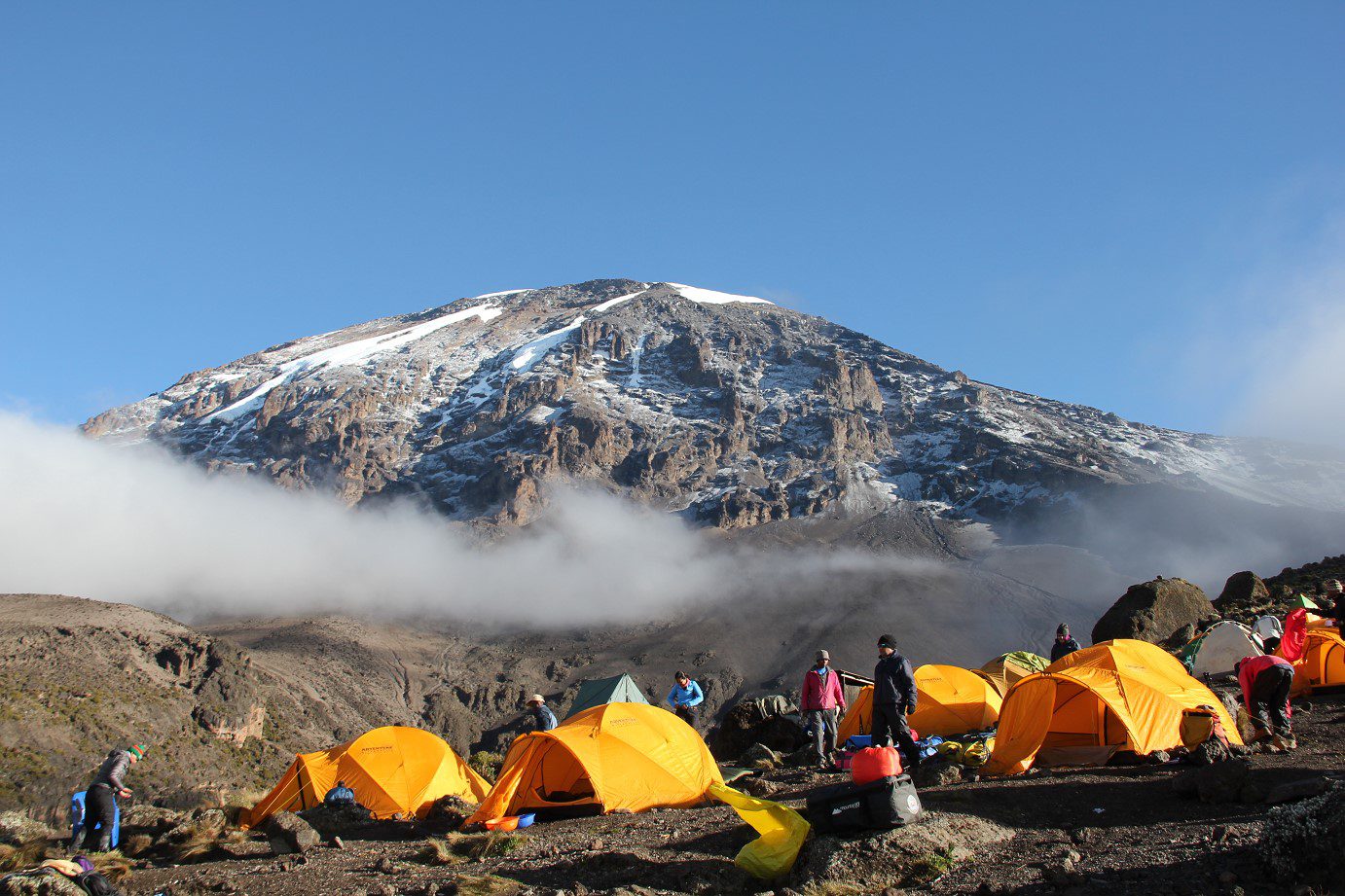
Perhaps one of Kilimanjaro's most iconic and perplexing features is its persistent snow and ice cap, despite being located just 3 degrees south of the equator. This anomaly is a direct consequence of its extreme height, which pushes its summit into the Earth's upper atmosphere, where temperatures plummet. The prevailing winds carry moisture that falls as snow and ice, accumulating over millennia to form glaciers that cling to the summit. However, this magnificent spectacle is also a poignant indicator of global climate change, with the ice cap having significantly receded in recent decades. The presence of snow and glaciers at its summit, near the equator, is a rare and striking natural occurrence that contrasts sharply with the tropical climate below. The melting glaciers serve as a powerful visual reminder of humanity's impact on the planet, making Kilimanjaro a vital subject of glaciological and climate research.
Kilimanjaro’s Volcanic Formation: A Fiery Genesis
Kilimanjaro's very existence is a testament to the powerful geological forces that shaped the East African Rift Valley. It is a stratovolcano, composed of three distinct volcanic cones: Kibo, Mawenzi, and Shira. Kibo, the highest, is a dormant volcano, while Mawenzi and Shira are extinct. Their formation involved millions of years of successive eruptions of lava, ash, and rocks, slowly building up the colossal edifice we see today. The volcanic soils are incredibly fertile, contributing to the rich biodiversity found on their lower slopes. The caldera on Kibo's summit, a massive crater formed by collapse after a major eruption, offers a dramatic glimpse into the mountain's fiery past, a constant reminder of the dynamic Earth beneath our feet.
Kilimanjaro’s Biodiversity and Resources: A Living Treasure
Beyond its dramatic landscapes, Kilimanjaro is a crucible of biodiversity. Its varied ecosystems support a wide array of plant and animal species, many of which are endemic to the region. The mountain's forests act as vital water catchments, feeding numerous rivers and streams that sustain local communities and wildlife for miles around. These water resources are crucial for agriculture and daily life in the arid plains below. Furthermore, the mountain's rich volcanic soils support thriving coffee plantations on its lower slopes, contributing significantly to the local economy. The preservation of Kilimanjaro's natural resources is therefore not just an ecological imperative but also an economic and social necessity for the surrounding region.
- Black-and-white colobus
- Blue monkeys
- Elusive leopards
- Giant groundsels
- Giant lobelias
- Kilimanjaro impatiens
- Coffee farms on fertile slopes
- Water for surrounding communities
Kilimanjaro’s Cultural Significance: A Sacred Sentinel
For centuries, Mount Kilimanjaro has held profound cultural significance for the local Chagga people and other indigenous communities living in its shadow. It is not merely a mountain but a sacred entity, deeply interwoven with their mythology, spirituality, and daily lives. Legends speak of deities residing on its peaks, and its presence influences rituals, traditions, and a deep respect for nature. The mountain serves as a symbol of strength, resilience, and connection to the land. Its majestic presence has also inspired countless explorers, artists, and writers from around the globe, becoming a global icon of natural beauty and adventure.
- Kilimanjaro is the world’s tallest freestanding mountain.
- Kilimanjaro is part of the ancient Seven Wonders of the World.
- Kilimanjaro lies about 3° south of the equator.
- The Chagga people live on Kilimanjaro’s slopes.
Is Kilimanjaro One of the Seven Wonders of the World?
Kilimanjaro is widely recognized as one of the Seven Natural Wonders of Africa and is often included in lists of the world’s most remarkable natural features. It is not part of the commonly cited “Seven Wonders of the World” list, which typically refers to ancient structures or man-made marvels. It is also one of the “Seven Summits”, the highest mountains on each continent.
Mount Kilimanjaro is the natural wonder most associated with Tanzania, a towering volcano considered iconic for its immense size and snow-capped peak. What makes it so special? It is one of the Seven Summits, the highest mountain in Africa and one of Africa’s seven natural wonders, and climbing it means hiking through five climatic zones on a single freestanding mountain.
The Seven Natural Wonders of Africa
The Seven Natural Wonders of Africa are the Nile River, Mount Kilimanjaro, the Sahara Desert, the Serengeti Migration, the Ngorongoro Crater, the Okavango Delta and the Red Sea Reef. Together they showcase Africa’s diverse landscapes and ecosystems. Visiting Kilimanjaro offers a unique and rewarding experience: it is one of the Seven Summits, brings a profound sense of personal accomplishment and stunning natural beauty, supports the local economy and is an important site for climate change research.
Kilimanjaro at a Glance: Nature, Environment and Importance
Mount Kilimanjaro is a dormant stratovolcano, also known as a composite volcano: a tall, cone-shaped mountain built up by layers of hardened lava, volcanic ash and rock from past eruptions. It is made up of three volcanic cones. Kibo, the highest and central cone, is dormant and could potentially erupt again, though its last significant eruption was about 360,000 years ago and there are no current signs of imminent activity. Mawenzi and Shira are extinct.
Kilimanjaro is a massive, dormant volcanic mountain in Tanzania, Africa’s highest peak at 5,895 meters (19,341 feet) and the world’s largest freestanding mountain. It is characterized by its three cones and a prominent, though rapidly shrinking, snow and ice cap. Rising dramatically from the surrounding plains, it features five distinct ecological zones, from cultivated farmland and rainforest to heath, alpine desert and an arctic summit zone with glaciers.
Kilimanjaro’s environment is defined by five distinct ecological zones, each with its own climate, flora and fauna, ranging from lush rainforest at lower elevations to a harsh, icy arctic zone at the summit. Climbing the mountain combines personal accomplishment, breathtaking natural beauty and cultural significance, and offers a chance to witness diverse ecosystems and wildlife unlike anywhere else on Earth.
Kilimanjaro is Africa’s highest peak and the world’s tallest freestanding mountain, standing independently of any mountain range. It is one of the famous Seven Summits and an accessible trekking mountain that doesn’t require technical climbing skills. From lush rainforest to alpine meadows, its slopes are home to a wide range of habitats, each supporting its own plant and animal life, a testament to its ecological significance as a haven for wildlife.
Mount Kilimanjaro is important as Africa’s highest peak and the world’s tallest freestanding mountain, a vital source of freshwater for surrounding areas, a home to rich biodiversity and diverse ecosystems, a place of cultural significance to local communities, and a magnet for adventure tourism and scientific study. Its summit, Uhuru Peak, offers stunning views, and it is part of the Seven Summits challenge for climbers.
How Was Kilimanjaro Formed, and When Did It Last Erupt?
Mount Kilimanjaro was formed by volcanic activity along the East African Rift, mainly through the accumulation of lava and ash over hundreds of thousands of years from its three volcanic cones: Shira, Mawenzi and Kibo. Its last major eruption occurred about 360,000 years ago, though smaller volcanic activity may have occurred as recently as 200,000 years ago. Learn more about Kilimanjaro geology and Mawenzi Peak.
The Biggest Natural Wonder and the Meaning of “Kilimanjaro”
Mount Everest, the highest peak on Earth, caps the Himalayas and separates the plains of the Indian subcontinent from the Tibetan Plateau. First climbed in 1953, it may be easier to visit than ever, but it remains a supreme natural wonder. Kilimanjaro, meanwhile, holds the title of the world’s tallest freestanding mountain.
The name Kilimanjaro is commonly accepted as a mix of the Swahili word kilima, meaning mountain, and the KiChagga word njaro, meaning whiteness, giving “Mountain of Whiteness”. Another theory suggests it is a European pronunciation of a KiChagga phrase meaning “we failed to climb it”.
Is a Volcano a Natural Wonder?
Yes. Parícutin Volcano in Mexico’s Michoacán state is one of the most extraordinary natural phenomena in the world and is often listed among the seven natural wonders of the world, famed as the youngest volcano on Earth, whose birth was witnessed and recorded by humans. Kilimanjaro is a volcanic wonder too: with phenomenal views, a trek that feels like walking from the equator to the North Pole, and a snow-covered summit above dry savannah and incredible life forms, it is often called one of the greatest natural wonders of the world.
Final Thought
Mount Kilimanjaro's status as a natural wonder is undeniable. Its solitary grandeur, breathtaking ecological diversity, enigmatic snowcap near the equator, dramatic volcanic genesis, abundant biodiversity and vital resources, and profound cultural significance all converge to create a truly unparalleled masterpiece of nature. It stands as a powerful reminder of Earth's intricate processes and the urgent need to protect its precious natural heritage for generations to come. The primary "mystery" of Mount Kilimanjaro centers around the uncertain origins and meaning of its name. Which has been debated by historians and linguists for centuries, though it's widely accepted to be a combination of words from local dialects. Additionally, the rapid melting of its iconic glaciers and ice cap due to climate change presents a significant environmental mystery and concern for scientists and observers.
Kilimanjaro Natural Wonder: FAQs
Why is Kilimanjaro considered a natural wonder?
Kilimanjaro is Africa’s highest mountain and the world’s tallest freestanding mountain, rising alone from the plains. It packs five climate zones, from rainforest to arctic summit, into one climb, carries glaciers just south of the equator and has a dramatic volcanic history, earning its place among Africa’s Seven Natural Wonders.
Is Kilimanjaro a UNESCO World Heritage Site?
Yes. Kilimanjaro National Park was inscribed as a UNESCO World Heritage Site in 1987, recognized for its exceptional natural beauty as the highest freestanding mountain in the world, its snow-capped summit and the forests and ecosystems on its slopes.
How many of Africa’s Seven Natural Wonders are in Tanzania?
Three: Mount Kilimanjaro, the Ngorongoro Crater and the Serengeti Migration, which Tanzania shares with Kenya. You can combine all three on one trip with a Kilimanjaro climb and a Northern Circuit safari.
Can a beginner climb Kilimanjaro?
Yes. Kilimanjaro is a non-technical trek, so no climbing experience is needed. Good fitness, training hikes and a longer itinerary of seven or more days give beginners the best chance of reaching Uhuru Peak safely, with experienced guides managing acclimatization.
Will Kilimanjaro’s glaciers disappear?
Kilimanjaro’s ice has shrunk by more than 80 percent since the early 20th century, and scientists expect much of the remaining ice could disappear in the coming decades. Seeing the summit glaciers today is a rare privilege.
What animals live on Kilimanjaro?
The rainforest is home to black-and-white colobus and blue monkeys, bushbuck, duikers and elusive leopards, with elephants occasionally seen on the lower slopes. Higher up, wildlife thins out, though white-necked ravens are common around the high camps.
What does the name Kilimanjaro mean?
The most widely accepted meaning combines the Swahili word kilima, meaning mountain, with the KiChagga word njaro, meaning whiteness, to give “Mountain of Whiteness”. Another theory links the name to a KiChagga phrase meaning “we failed to climb it”.
When is the best time to see Kilimanjaro’s snowy summit?
The clearest views usually come in the dry seasons, January to March and June to October, especially early in the morning before clouds build. Lodges in Moshi, Amboseli and around the mountain’s foothills offer classic sunrise views of the snow-capped peak.
Experience This Natural Wonder
Walk from rainforest to arctic summit on Africa’s highest mountain. Tell us your dates and fitness, and our mountain team will plan a safe private Kilimanjaro climb, with a safari to the Serengeti and Ngorongoro if you wish.